
- Title: A Simple Framework for Contrastive Learning of Visual Representations
- Citations: 33,428 (as of July 11, 2026)
- Link: https://arxiv.org/pdf/2002.05709
- ICML 2020
Previous approach to learn visual representation
- Generative approaches
- A generative method attempts to model or reconstruct the input data.
- SimCLR paper says that pixel-generation can be computationally expensive and may not be necessary for representation learning.
- Discriminative approaches
- Discriminative approaches trains the network to distinguish among alternatives or predict a target.
- SimCLR is called discriminative because it distinguishes the correct pair from incorrect pairs. It does not generate image pixels.
Main Results (ImageNet)
- achieves 76.5% top-1 accuracy
- 7% relative improvement over previous SOTA (the performance of a supervised ResNet-50)
- achieve 85.8% top-5 accuracy
- fine-tuned on only 1% of the labels.
- outperforming AlexNet with 100× fewer labels
Figure 1 Results
- SimCLR outperformed earlier self-supervised methods
- Self-supervised learning benefits strongly from model scaling
- Strong self-supervised representations can approach supervised performance
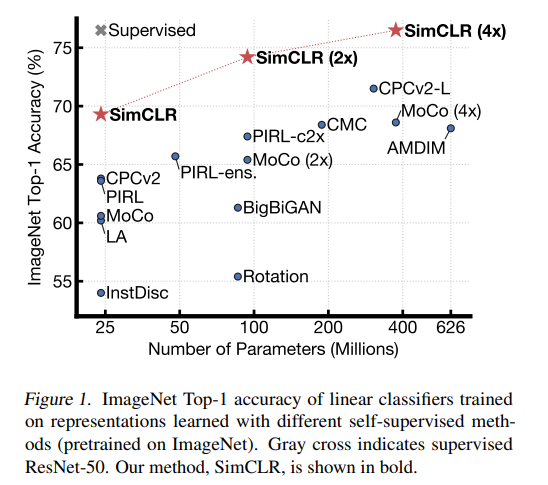
- Blue circles: previously published self-supervised methods
- Red stars: SimCLR models
- The “2×” and “4×” refer mainly to network width, not directly to parameter count.
- Gray cross: standard supervised ResNet-50, trained using ImageNet class labels.
SimCLR : self-supervised contrastive learning (training target is constructed automatically from the data)
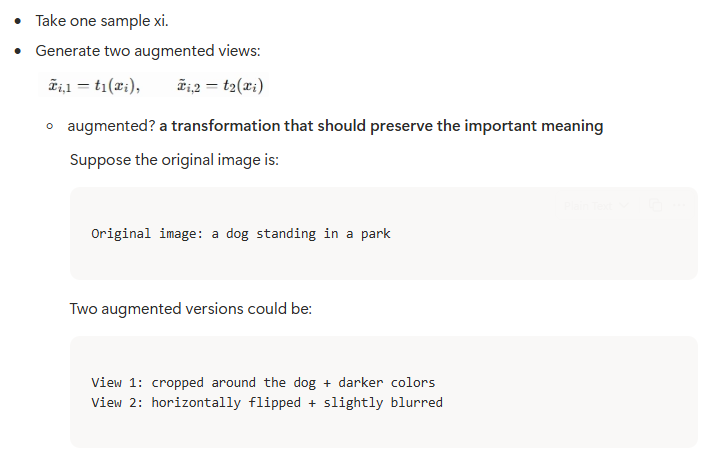
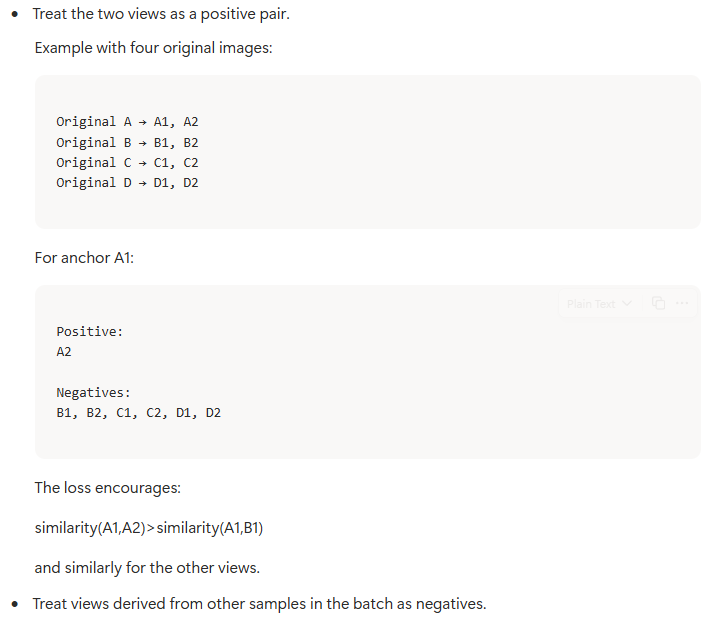
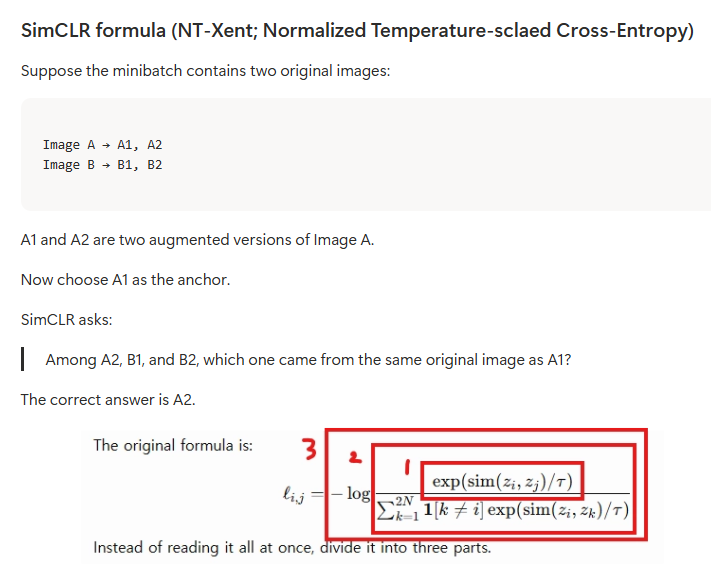
Importance of SimCLR
Data augmention Results
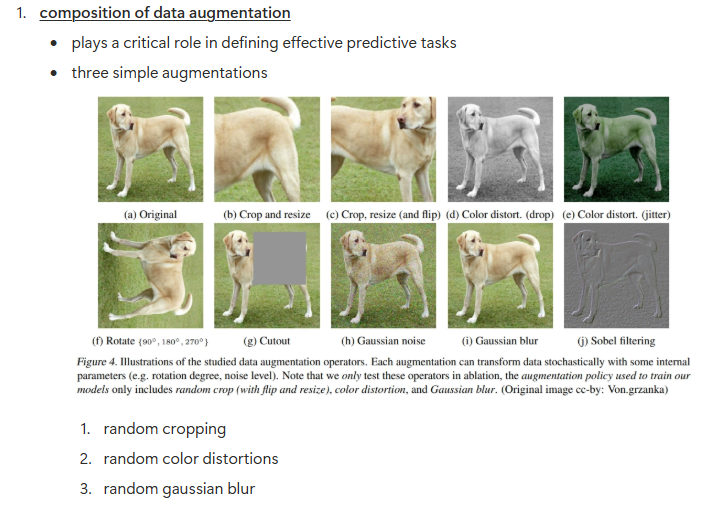
“composition of data augmentation plays a critical role in defining effective predictive tasks”
→ A good augmentation should preserve semantic identity while removing easy shortcuts.
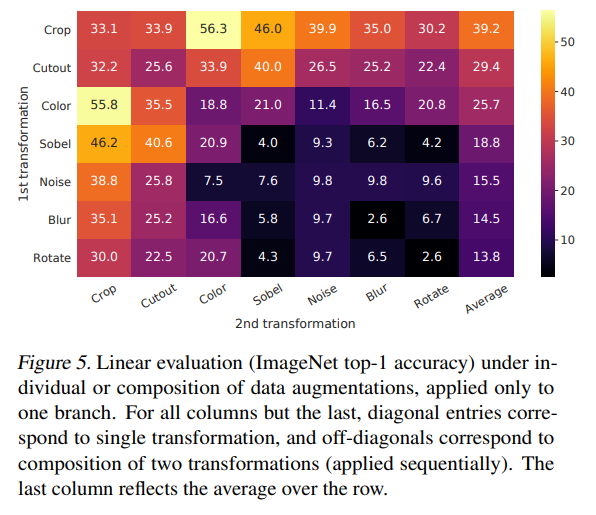
Figure 5: Which augmentations produce useful representations?
The values are ImageNet linear-evaluation accuracies.
How to read it
- Diagonal cells: only one augmentation
- Off-diagonal cells: two augmentations applied sequentially
- Last column: average performance for that row
For example:
- Crop only = 33.1 (this can be too easy)
- Crop + Color = 56.3
→ Single transformations perform poorly
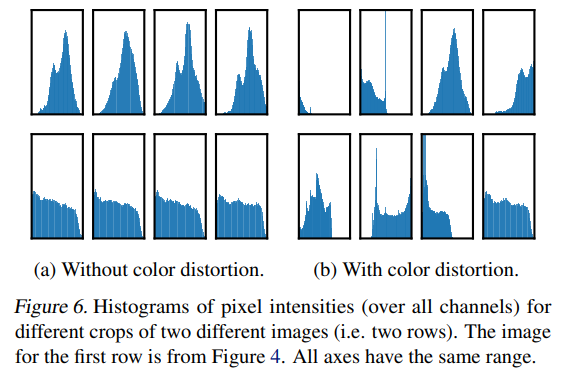
Figure 6: Evidence for the color shortcut
Figure 6 shows pixel-intensity histograms for different crops.
- (a) Without color distortion → color can match positive crops. without recognizing the actual semantic content
- shapes are fairly similar.
- why? still contain similar colors
- shapes are fairly similar.
- (b) with color distortion → it have to use more stable features. (such as: object shape, body structure,.. )
- Even though all four crops still came from the same dog image, their histograms now look very different.
- the model can no longer use the color histogram as a reliable fingerprint.
- Even though all four crops still came from the same dog image, their histograms now look very different.
So, it can be said “Harder contrastive task can produce a better representation”
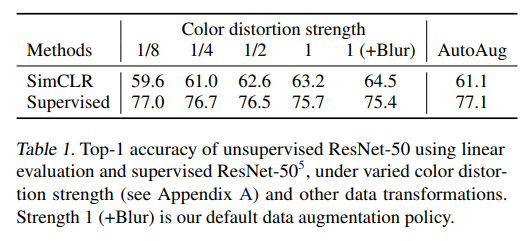
Table 1. Stronger data augmentation improves performance in SimCLR (not in Supervised)
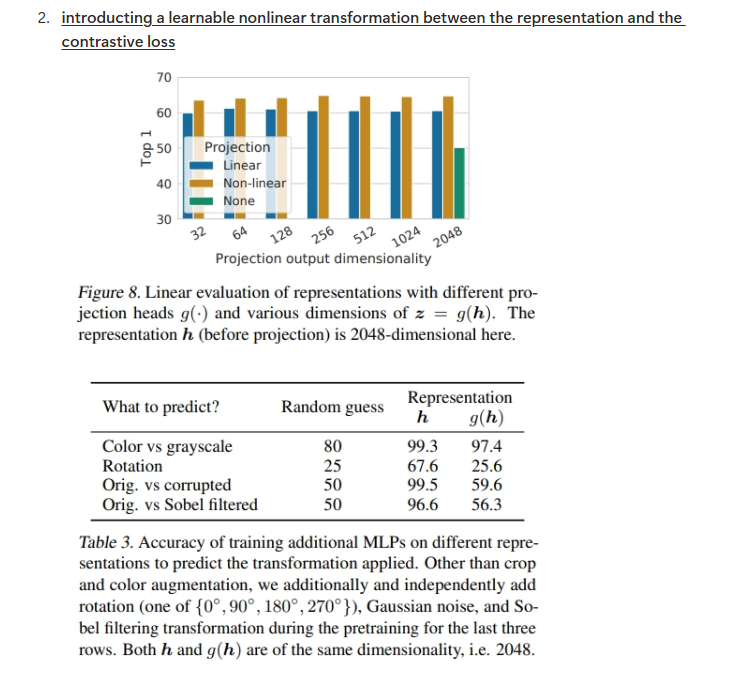
How much information about the applied image transformation remains in h and in g(h)?
-h: output of the main encoder
-g(h): output of the projection head, used for the contrastive loss
- Random guess: accuracy expected without useful information. baseline
- Representation information: h>g(h)
→ SimCLR design: use hfor downstream tasks.
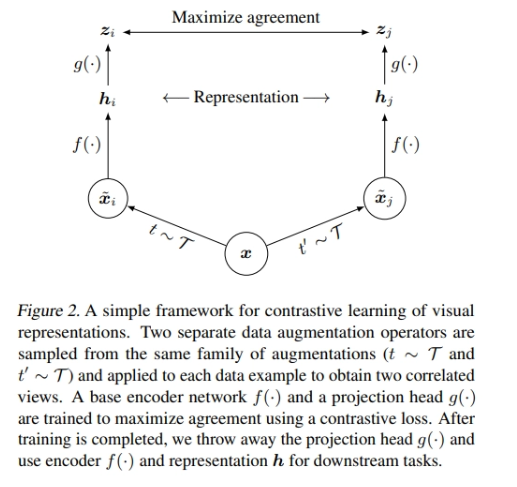
SimCLR Summary
- Goal: Learn useful image representations without class labels.
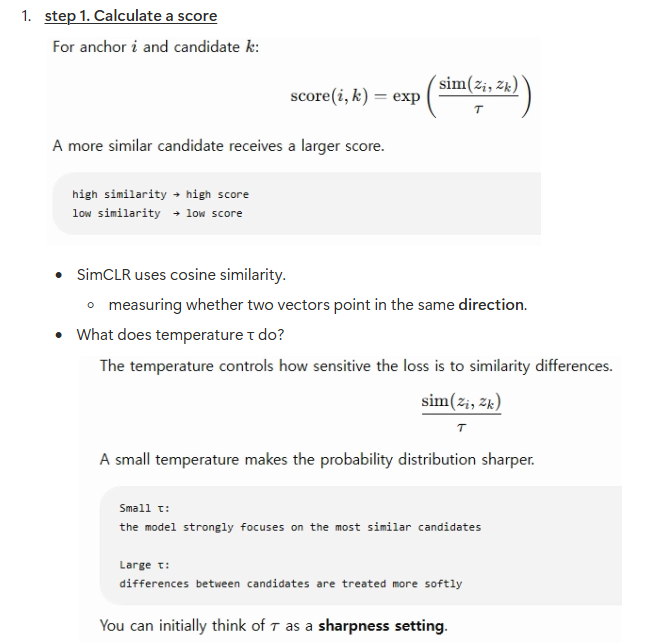
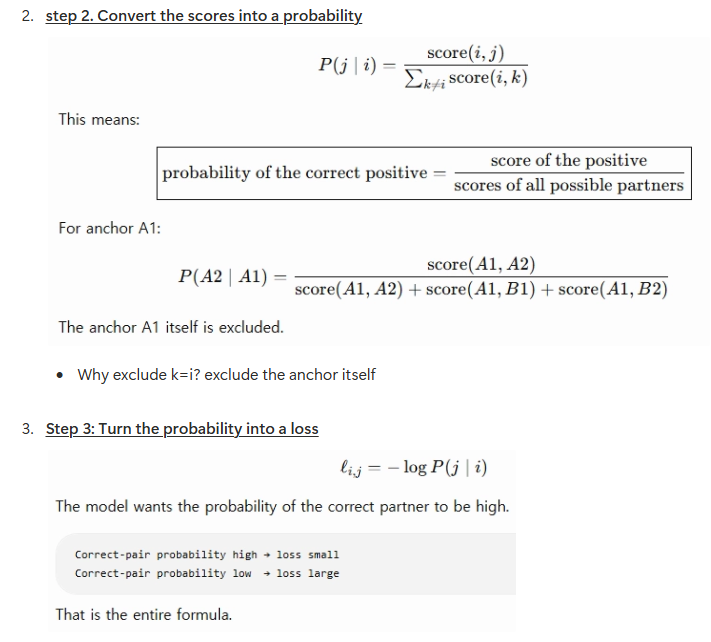
- Method: Create two augmented views of the same image, pull their embeddings together, and push embeddings of other images apart using NT-Xent loss.
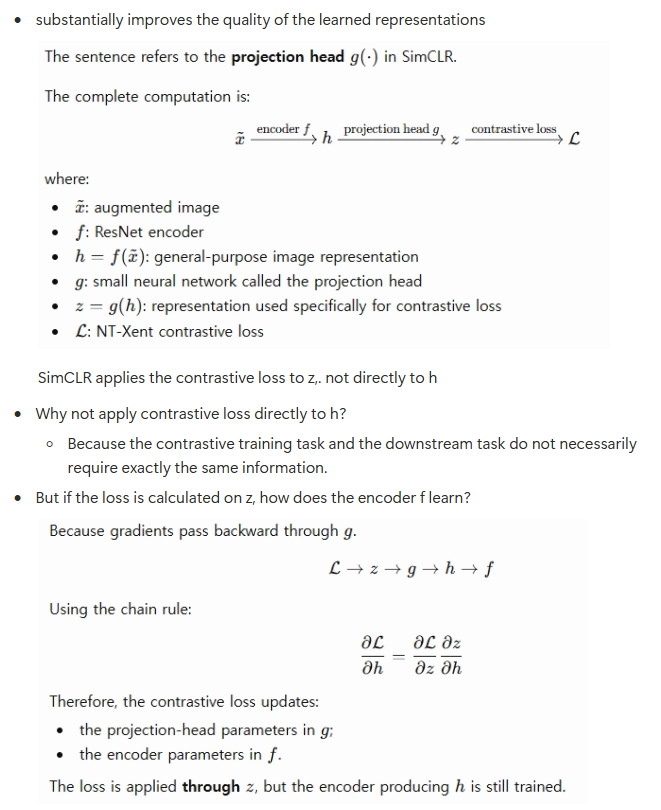
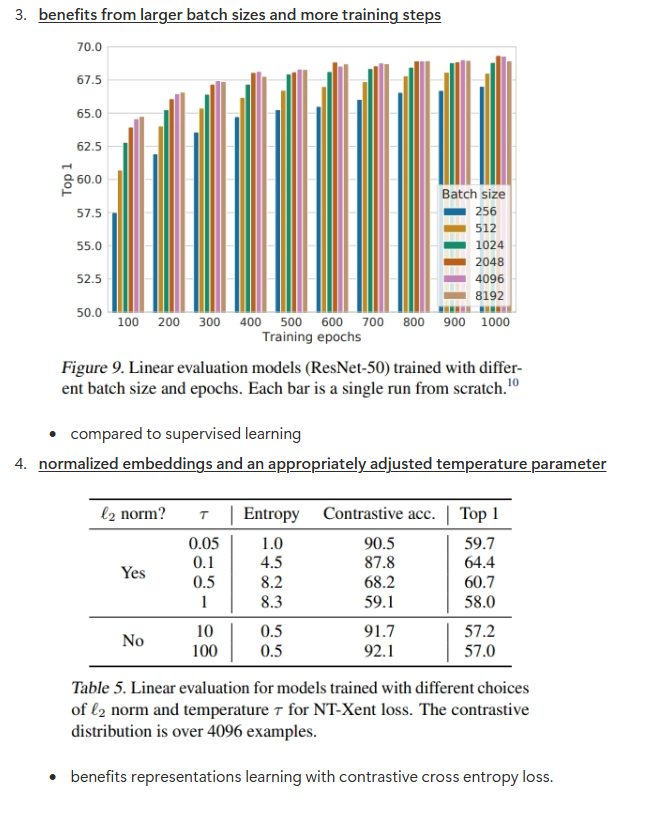
- Key finding: Strong augmentation—especially random crop plus color distortion—and a nonlinear projection head are critical for good performance.
- Significance: SimCLR showed that a simple contrastive framework can learn representations competitive with supervised pretraining.

